
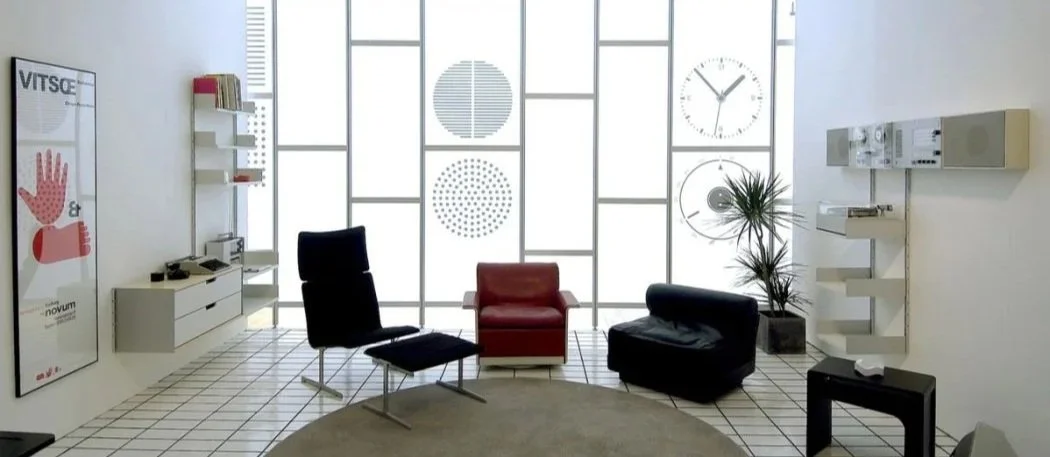
Dieter Rams for Vitsœ.
Sometime during the eighties, the Modernist logic of “form follows function” has widely transitioned into “as little design as possible”. Consciously or unconsciously, this principle from the industrial design scene, as professed by Dieter Rams, has defined the aesthetic behind most commercial furniture and interiors for roughly the past half-century. It has done more than shape household appliances, furniture or even buildings; it has paved the way to what is commonly understood today to be “elegant”, effectively defining a general notion of taste as such on an international level. While “form follows function” is experienced as a rupture, “as little design as possible” feels like a consolidation through synthesis of existing norms.
In theory, to create an object with as little design as possible implies that its visual appearance bears no elements beyond what is strictly necessary. In practice, particularly today, the same principle commonly refers to what has come to be considered as “minimal design”, almost always involving monochrome (preferably white) surfaces, smooth transitions, round edges, but perhaps more importantly a homogenised aesthetic, a sterilised “elegance”. Originally exemplified by early Braun and Apple products, “as little design as possible” seems like a continuation of the Modernist ethos through new available technologies, such as injection moulding and the CNC. I would interpret its origins in the works of the Bauhaus, Le Corbusier, but also Joe Colombo and the Antidesign movement.
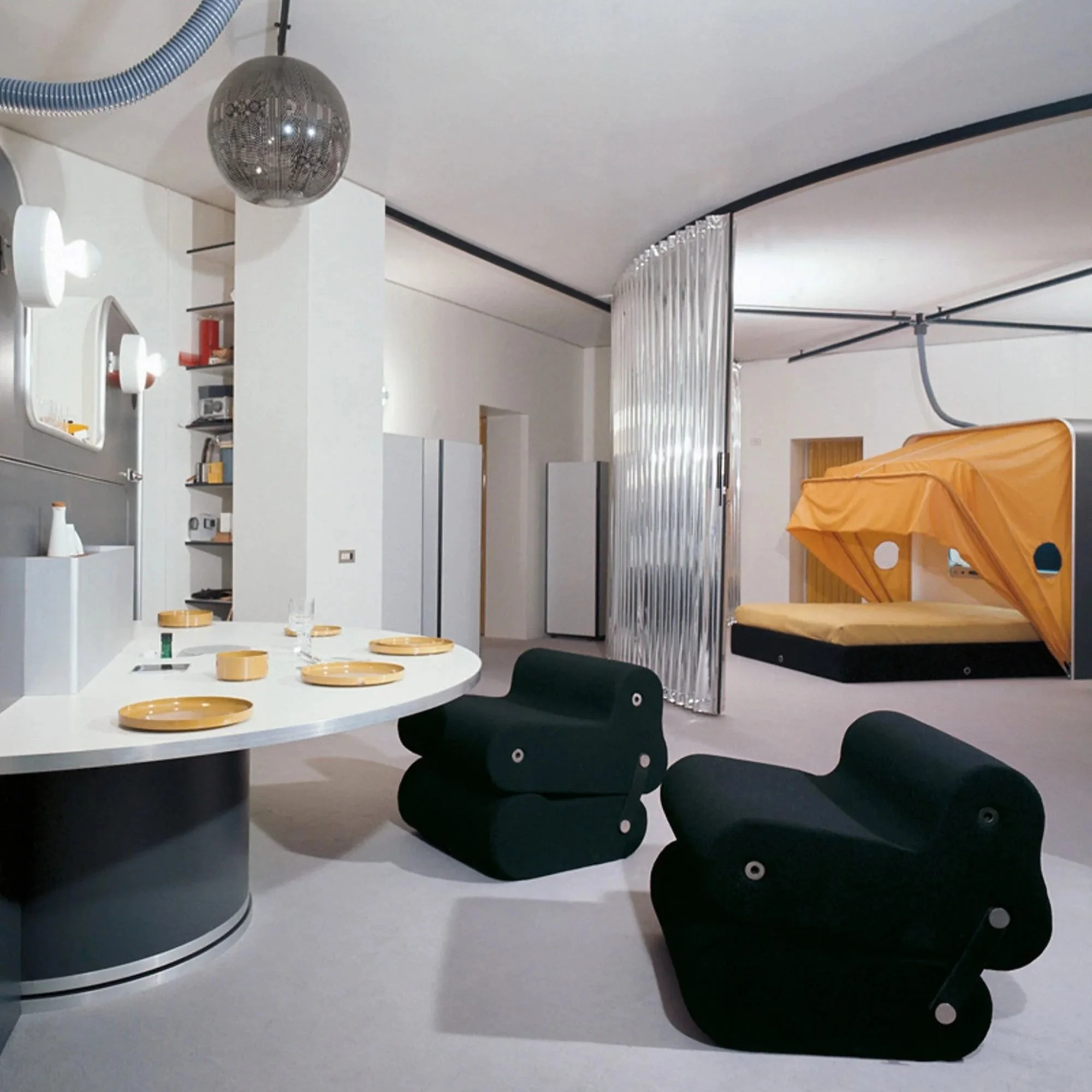
Roto-Living, Joe Colombo.
While looking into the latter through the lens of Alexandra Midal in Design by Accident (2019), I was struck by the paradox which she points out, and defends, between Colombo’s ideas and their materialisation through furniture and interior design. Although Antidesign promoted an intuitive connection between the subject and the living space, I found the omnipresence of gadgets and integrated features to make this connection impossible, even leading to alienation instead. I tend to agree with Reyner Banham, who referred to this trend of filling one’s environment with gadgets and gimmicks as “gizmology”. In his 1965 essay titled The Great Gizmo, Banham describes the typically American gizmo as a “small and self-contained unit of high performance in relation to its size and cost, whose function is to transform some undifferentiated set of circumstances to a condition nearer human desires”. Considering furniture and interior design, this reminded me of the current trend of adding electronic components in every piece of hardware, whether it be automated hinges, storage systems that vertically disappear into a countertop, or the insatiable need to integrate LED lights in every corner. To truly complete the aesthetic today, one must be able to boast about how their interior was fully designed using AI, with AI-generated house music playing in the background, as the kids watch AI-generated cartoons, all while sipping coffee that came out of a capsule, or tea infused in boiling water straight from a Quooker tap. The only gizmo currently missing is a Tesla robot, which is probably for whom these living spaces will be designed soon anyway.
Fundamentally, the design principles laid out by Dieter Rams assumed that household items, furniture and buildings should cater to the needs of people interacting with them. Where the subject was then considered to be the end-user, today it is rather the corporation collecting the subject’s data. An “elegant”, “minimal” and “functional” aesthetic leverages this ambition by ultimately suggesting neutrality. The impossibility of this neutrality has been articulated brilliantly by Brian ‘O Doherty in Inside the White Cube (1986), where he discusses the modern gallery space and its attempt to rid itself of an ideological framework, ultimately to favour a commercial objective. Although Google and ChatGPT are both trying to convince me that the origins of the “minimal” home aesthetic is primarily the Minimal Art movement from the sixties and seventies, I would personally argue that its patient zero is probably an early twentieth-century gallery space, with all its perfectly square walls painted white, serving as a background for artworks to be sold. For a decorative style that is fundamentally devoid of substance, the “minimal” interior’s connection to Minimal Art bears too little theoretical overlap, and too little superficial resemblance for that matter.
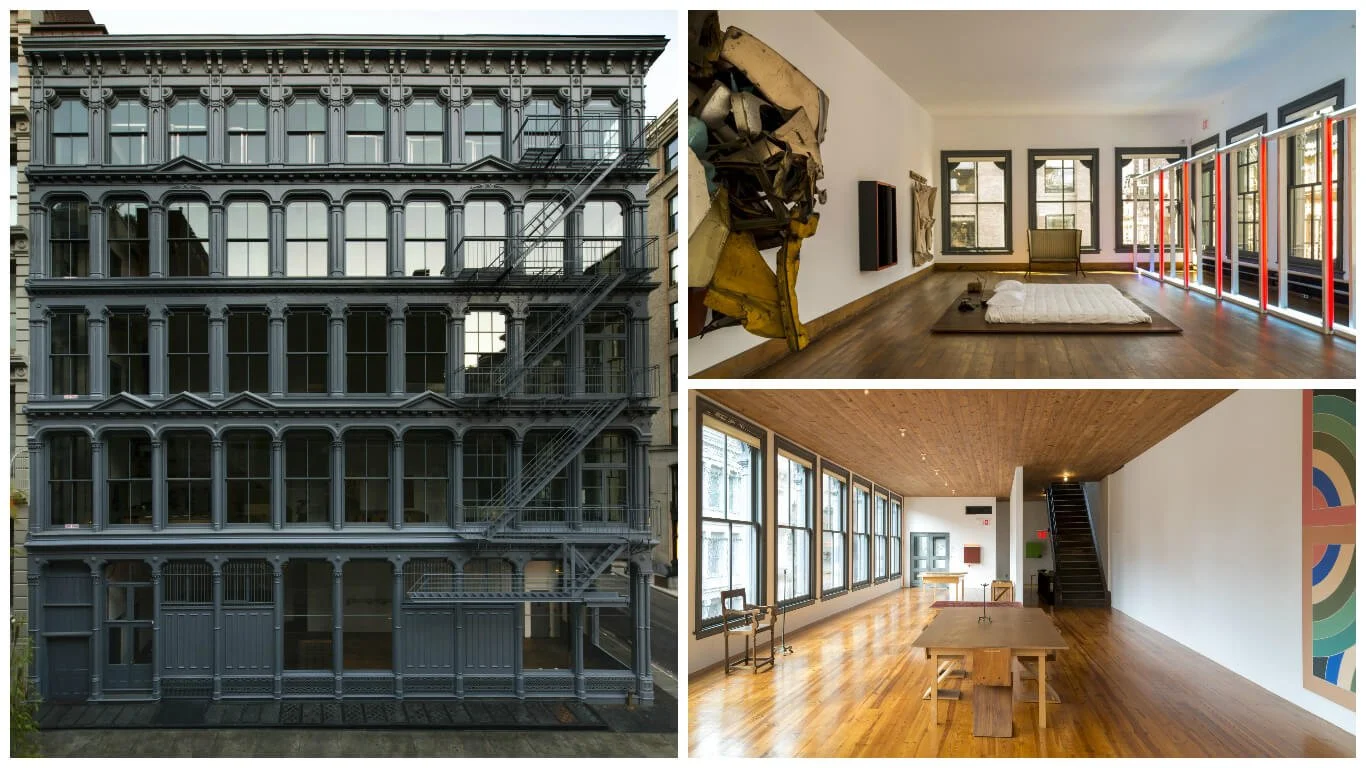
Donald Judd’s residence and studio on 101 Spring Street, New York.
Perhaps a more relevant philosophy for such an aesthetic can be observed from Patrick Bateman in American Psycho, whose high-rise cosmopolitan luxury apartment presents a curated ensemble of design icons and artworks, all exhibited against flawlessly plastered white walls, complemented by a centrally positioned white sofa. The shades of white are contrasted (hardly) against a light oak parquet, while the kitchen is delineated by aluminium cabinetry. The result feels like a derivative of the International Style, reminiscent of an interior design championed by Jan des Bouvrie among others, exemplifying a specific section of contemporary architecture: that which has absorbed and appropriated the visual aesthetic of Modernism, while leaving behind its radical narrative, in search of neutral land.
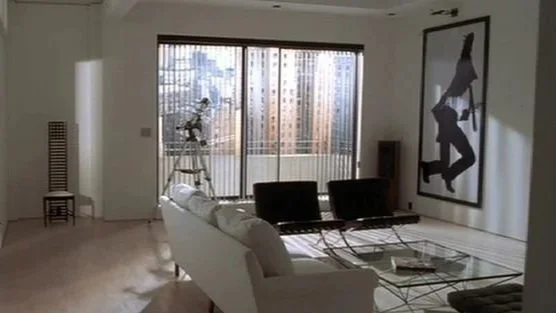
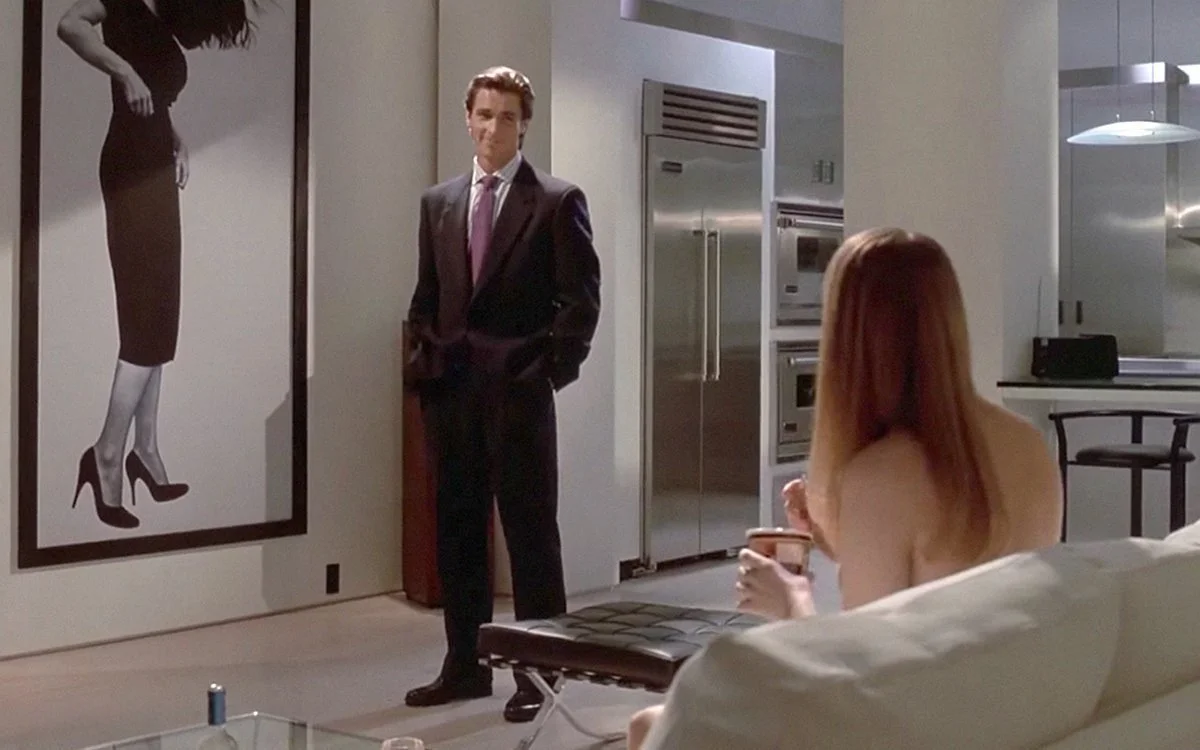
Today, this logic extends to other styles and movements, particularly to furniture affiliated with conceptual art. In a recent attempt by Kim Kardashian to integrate actual Minimalist furniture in her home, she was brought to court by the Donald Judd Foundation for showcasing imitations of Judd tables and chairs. Somewhat like the character portrayed by Christian Bale, one could argue that these design choices are motivated by a need to conform and promote “good taste”, rather than to fulfil the needs of a person, or convey any actual expression.
The latter argument is hardly new and has been the subject of intense discussion since the beginning of the industrial revolution. One notable example is The Theory of the Leisure Class (1899) in which Thorstein Veblen essentially suggests that utility is inversely proportional to appeal. In today’s logic, this statement can be extrapolated to the “minimal” space or object, i.e. the more it evokes neutrality, the more it exudes social status. Furthermore, the impartiality of a conventionally desirable space is best conveyed as a VR experience. Ideally, the digitally rendered space or object should no longer leave the screen to be translated into something tangible. Rather, the subject should be drawn inside the 3D drawing software.
With the development of AI, it is often suggested that the practice of design is under threat of being taken over by algorithms. This will certainly be the case for all formulaic design in service of neutrality, funnelling data towards an industry whose objective is to eventually eliminate the human factor. The homogenisation of “good taste” provides the algorithms with ample information on how to design a generic space based on desire rather than necessity. The result is almost always “minimal” with no substance, plainness for the sake of its aesthetic, synthetic posing as organic. Today’s furniture and interior design trends indicate a departure from the basis provided by “as little design as possible”. Perhaps a fitting name for the current style would be “Neutralism”, i.e. a decorative trend resulting from the appropriation of Modernism’s visual language. Neutralism occasionally appears in colourful variations, as a homogenised amalgamation of later movements, such as Minimalism or the Memphis Group.
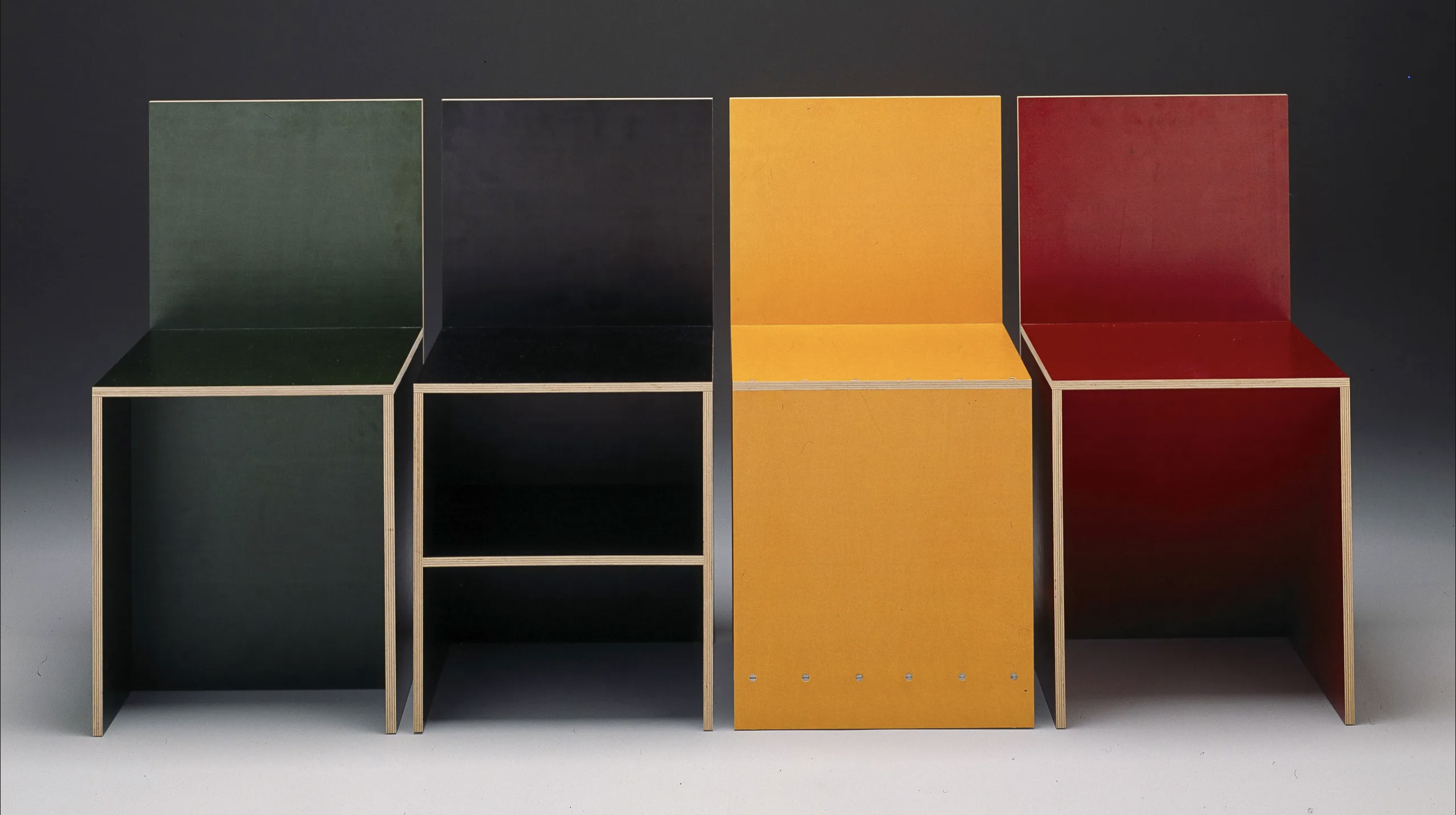
Chair 84, Donald Judd.
The principles for an alternative way forward can be laid out in the words of Reyner Banham on Brutalist architecture: an ethic, not an aesthetic. A contemporary interpretation of this idea can guide us towards an elementary formalism: design in service of daily life, using materials in their raw state, and produced through methods that enable an intuitive relation between subject and object. The zeitgeist calls for work that does not give a shit about “good taste”.
References
Midal A (2019) Design by Accident. Sternberg Press.
Banham R (1965) The Great Gizmo. In Penny Sparke (ed), Design by Choice. London: Academy Editions, 108–114.
‘O Doherty B (1986) Inside The White Cube: The Ideology Of The Gallery Space. San Francisco: The Lapis Press.
Harron M (Director) (2000) American Psycho [Film]. Santa Monica: Lions Gate Films.
Veblen T (1899) The Theory of the Leisure Class: An Economic Study in the Evolution of Institutions. New York: Macmillan.
Image courtesy
Vitsœ.
IF-Studio Joe Colombo, Vitra Design Museum. Photo: Andreas Sütterlin.
Donald Judd Foundation.
Lions Gate Films.
20th-Century Design Fund/Bridgman Images.